



“If I’m thrown into something physical, I can get afraid. But that’s not a code to live by. It’s a mood to move through - back to the depth that holds it.”
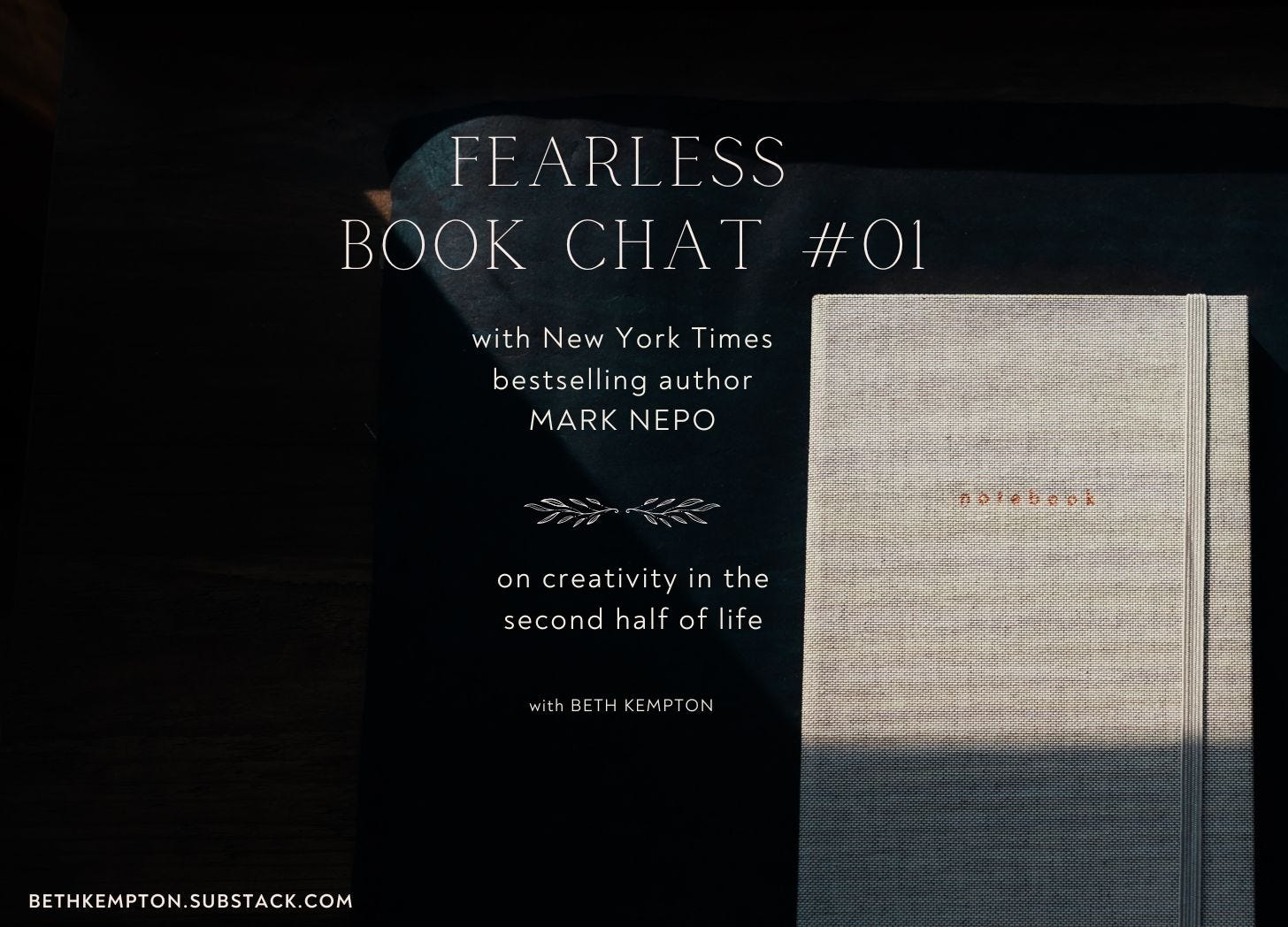
- Mark Nepo speaking on Fearless Book Chat #01
This week marks the third anniversary of The Way of the Fearless Writer being out in the world. The fact that the book even exists is something of a wonder, given how much self-doubt crept in as I wrote it. In fact, when I was working on the proposal for the book I had a veritable barrage: Who are you to write a book about writing? Millions of people write. What’s so special about you? This rapidly became: You haven’t written enough. You don’t know enough. You know how it goes. And then it got nasty: You want to write a book about being a fearless writer, and yet look at you, doubting yourself. What a joke.
At that exact moment a deck of affirmation cards jumped off the shelf in front of my desk and landed on my notebook. No word of a lie. My husband heard me scream. On the front of the deck it said: ‘I am enough exactly as I am.’ I took that as a sign to carry on, and here we are.
I wanted to do something special to mark this milestone, so I decided to create a new series of potent interviews with authors who have had a great impact on my own writing life. I have called this series Fearless Book Chat, in the hope that I can fearlessly ask thought-provoking questions about creative living and book writing to some of the most outwardly successful writers of our time, and in doing so hear about how they deal with fear and self-doubt, and keep going, building a life doing what they love.
I am thrilled to open with a beautiful conversation featuring New York Times bestselling author
. Mark is one of my writing heroes. I actually have so many of his books that I have a ‘Mark Nepo shelf’ in my writing room. I have turned to his words many times over the years for comfort and wisdom, so I was deeply honoured when he agreed to be my first guest. I hope you love listening. We talked about many things, including his new book The Fifth Season: Creativity in the Second Half of Life, which I highly recommend as a companion on the wild and beautiful road of life.
Reading Mark’s book reminded me that I only began writing books as I entered my forties. I’m now working on book #7, which means that writing books and navigating midlife have gone hand in hand for me. While the truth is the older I get the more I realise I don’t know, I can also see how the creative act of writing in this life stage has been incredibly helpful in terms of finding calm in all kinds of storms, nurturing the curiosity which makes life interesting, and shifting my focus to what matters. For that I will be forever grateful.
When I was thinking about this, I had a look back through various photographs of my books out in the wild, and I came across this one of The Way of the Fearless Writer, which I took at Nanzenji Temple in Kyoto, soon after the US edition came out.
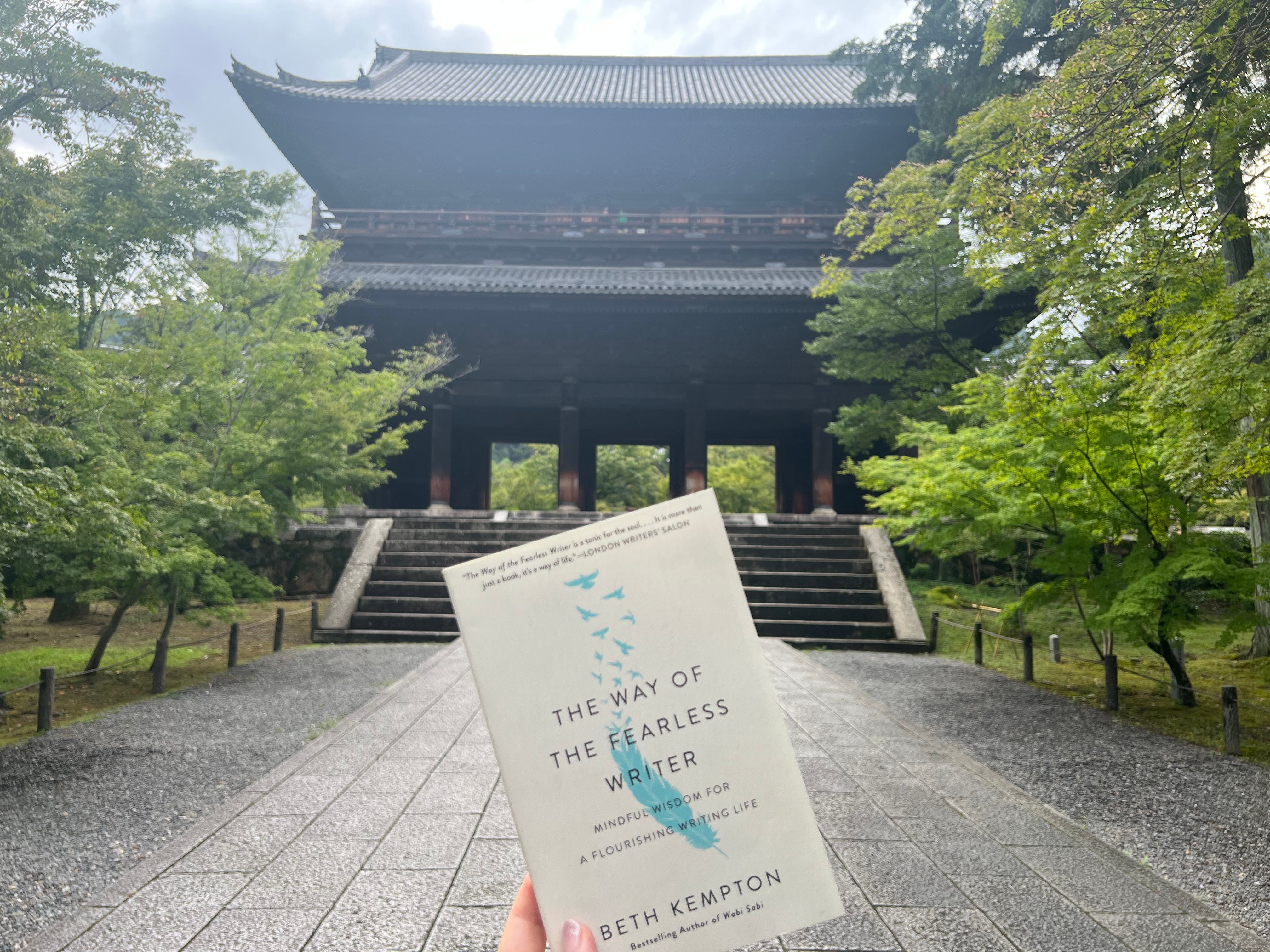
I remember I had wanted to take a photograph of it in front of the huge entrance gate known as the Sanmon, before any visitors arrived. Sanmon (三門) means ‘three gates’ and refers to the Three Gates of Liberation in Buddhism: desirelessness, formlessness and emptiness, the same three ‘gates’ which had showed themselves as essential in becoming a fearless writer and inspired the three-part structure of the book.
I flicked through to the part about Nanzenji, and found that I had written this:
The fearless writing path is actually a pathless path, unfolding with each step and leading us not from here to there, but from here to here. It is a path of waking up. Our work as fearless writers is to pass through these three gates over and over, every time we enter our sacred writing space. Shedding our fixed identity. Letting go of our desire and our need for control. Honouring the formlessness of our creative potential. Sensing the interconnectedness of everything. And practising. Always practising, to express the human condition and this strange and beautiful experience of existence, in words.
The gates have no doors. They are symbolic. There is nothing stopping us from passing through. We just have to keep showing up with courage, humility and grace as we cross the threshold between the mundane and the sacred every single time we choose to write, never quite knowing what will happen next.
I got full body shivers reading it. I had worked on that manuscript for months, writing and rewriting, editing and reading again. I had even recorded the audiobook version myself. And yet it wasn’t until that moment at Nanzenji that I fully realised that what I had written was not just true for writing. It was also true for life.
Anytime that I had sensed midlife malaise in recent years, it had shown up because I was focused on my own desire. I had a fixed vision of how I wanted my life to be, but got frustrated when it didn’t look exactly that way. I had the kind of audacious, specific and time-bound goals we are so often told we need to have if we are going to achieve anything useful. Sometimes, I would reach one but feel uncomfortable shouting about it. Sometimes, I failed to reach one, which was not a good feeling. Other times, delivering on the timelines was not compatible with things I really valued, like time with my young family. I carried around fear-filled questions such as:
How do I know if I am doing life right? (Read: I am afraid I’m doing life wrong.)
How can I be more efficient with my time? (Read: I am afraid I am not efficient enough, and that I am spending my time on the wrong things.)
What should I do about money? Should I be making more money? Should I care less about money? (Read: I am afraid I don’t have enough money, but more than that, I am afraid that not having enough money means I am not good enough.)
How can I balance the pull to do meaningful work with the needs of my family? (Read: I am afraid that the truth is these things are mutually incompatible.)
What will I regret years from now if I don’t do it at this point? (Read: I am afraid I am missing the boat on something, without knowing what that is, which makes it even worse.)
What if I make a choice and it is the wrong one? (Read: I am so afraid, I am choosing to do nothing, but I am also afraid I will regret that choice.)
(Anyone relate??)
It was exacerbated by the fact that I was obsessed with form. I had a particular idea of how I thought my life should be by now, based on my conditioning and what I saw when scrolling through social media. This is a slippery slope, where nothing is ever enough. I was very familiar with this, having written an entire book about how perfectly imperfect we are, so you’d think I’d know better, but our conditioning runs deep.
Finally, my midlife malaise had revealed the awkward truth that I was hostage to the idea of separateness. I saw most people as judge, critic and competition. As a result, I rarely asked for help, or shared where I was struggling.
Being by my mother’s side as she faced death in 2023, and navigating the path of grief all the way to the summit of Gassan, one of Japan’s most sacred mountains, in the wake of losing her, changed everything for me. As I wrote in Kokoro, that experience revealed my own patterns, and showed me how important it was for me to let them die too, in order to fully live. Of course I would rather have found out another way, without the intensity and devastation caused by the rupture, but sometimes this is how it goes.
Of course, it makes complete sense that what works for writing works for life, because writing is simply a way of accessing our deepest wisdom, capturing what we have sensed about the innermost nature of things and offering our natural creative response to the world. Writing, just like any other creative act, is an instrument of the kokoro - the intelligent heart. It is through our creative acts that the kokoro is made visible.
By midlife the kokoro refuses to be silenced any more. This is surely why so many of us get a desperate urge to do something creative at this point. That ‘something creative’ has many faces – from endeavours such as art, writing, and music, to house renovation, starting a new business, conscious parenting or innovating the way we live. It’s the kokoro’s way of seeking out new instruments to communicate our longings and deepest wisdom, and for responding to the beauty in the world.
This is what my conversation with Mark was all about, and it’s what his book The Fifth Season is all about. I hope you love listening. If you enjoy it, please do share it with your own readers. I’d love to know what resonates most, if you care to share in the comments.
Life happens, things change. We get pulled back towards desire, and form, and separateness, and we have to keep recommitting to what will free us: desirelessness, formlessness, emptiness. The gates have no doors. They are symbolic. There is nothing stopping us from passing through. We just have to keep showing up with courage, humility and grace as we cross the threshold between the mundane and the sacred every single time we show up to write - and really show up to live - never quite knowing what will happen next.
Beth Xx
WRITING LIFE INSIGHT - BONUS FOR SOULCIRCLE MEMBERS
Mark very kindly recorded an additional 25-minute piece sharing his insights into the world of publishing and staying true to your writing path. This open and inspiring conversation is now available HERE. If you aren’t yet a member but would like to listen, just upgrade to paid or go to bethkempton.substack.com/subscribe and choose Monthly to try it out, or Annual to get a lovely discount.
ABOUT MARK NEPO: With over a million copies sold, Mark Nepo has inspired readers and seekers all over the world with his #1 New York Times bestseller The Book of Awakening. Beloved as a poet, teacher, and storyteller, Mark has been called “one of the finest spiritual guides of our time,” “a consummate storyteller,” and “an eloquent spiritual teacher.” He has written twenty-five books, and his work has been translated into more than twenty languages. He was chosen by Oprah Winfrey as a member of her SuperSoul 100, a group of inspired leaders using their gifts and voices to elevate humanity. You can find him here on Substack
.
Images:


